Mature trees can develop structural weaknesses long before they look unhealthy from the ground. Co-dominant stems, included bark, heavy horizontal limbs, old storm damage, and developing splits can place extra stress on important parts of the tree.
In selected cases, tree cabling and bracing can help reduce movement or support vulnerable sections so a mature tree can remain in place. It is not a universal fix, and it should not be used to avoid removal when a tree is already too compromised.
What Is Tree Cabling?
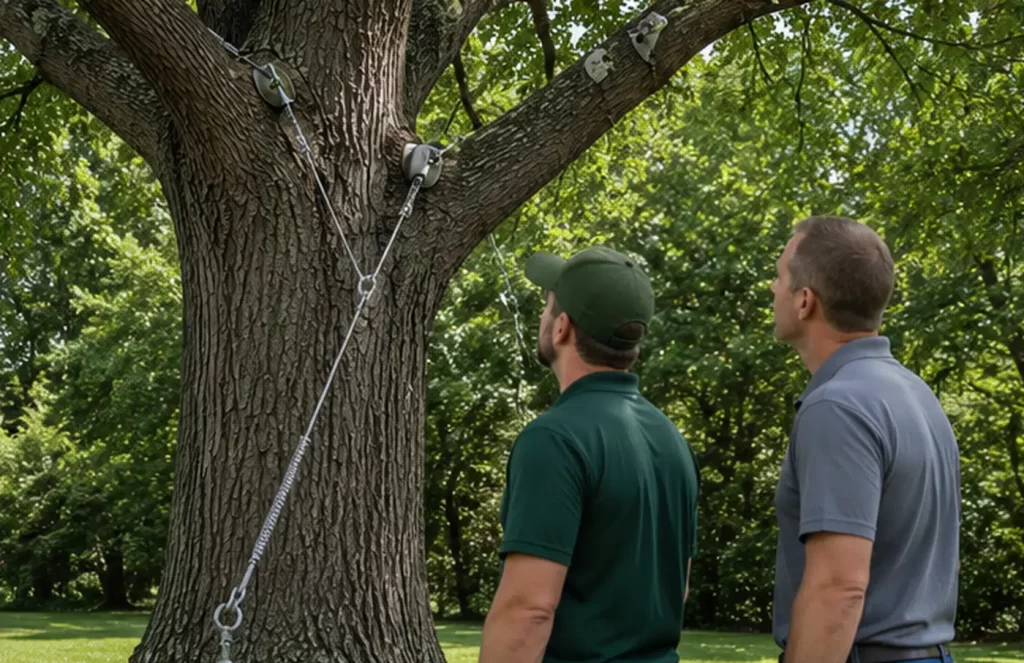
Tree cabling uses flexible support between major limbs or stems to reduce excessive movement and help share forces across the canopy. The goal is not to make the tree rigid. It is to reduce stress on a weak union or heavy limb when preservation is reasonable.
What Is Tree Bracing?
Bracing provides more rigid support in selected structural situations, such as a split or weak union. Bracing may be used alone or together with cabling depending on the tree and the defect.
When Might Cabling or Bracing Be Considered?
Co-Dominant Stems
Two large leaders growing from the same point can sometimes develop a weak union, especially when bark is included between the stems. Support may be considered when the tree is otherwise healthy enough to preserve.
Heavy or Overextended Limbs
A large horizontal limb can place significant leverage on its attachment point. Selective pruning may reduce some of that weight, while cabling may provide additional support when appropriate.
Developing Splits
A visible split does not automatically mean a tree can be saved. The severity, location, decay, remaining sound wood, and what could be damaged if the tree failed all matter. Some splits may be candidates for support; others may make removal the safer option.
Storm-Damaged Trees
Wind, snow, ice, and heavy rain can expose weaknesses that were already present. After a storm, support may be one option if the main structure is still viable and the defect can reasonably be managed.
When Cabling Is Not Enough
Cabling cannot restore severely decayed wood, repair major root failure, or guarantee that a dangerous tree will not fail. Trees with extensive decay, severe trunk damage, advanced root problems, or multiple serious defects may still need tree removal.
Does a Cabled Tree Still Need Pruning?
It may. Selective tree trimming and pruning can sometimes reduce deadwood, storm-damaged growth, or excessive end weight on a vulnerable limb. Support and pruning may work together as part of a larger preservation plan.
Does Cabling Require Follow-Up?
Yes. Trees continue to grow and change. Hardware, limb movement, new growth, storm exposure, and changes in tree condition all matter over time. A supported tree should be monitored and re-evaluated periodically.
What If the Tree Is Also Declining?
A structurally weak tree can also have health problems. Root-zone stress, pests, disease concerns, drainage, soil compaction, and construction damage may contribute to decline. Our plant health care and arborist services pages explain how those concerns can be evaluated alongside structural issues.
Tree Cabling and Bracing in Charleston, WV
Patriot Tree Experts provides cabling and bracing evaluations throughout Charleston and nearby communities. We look at the whole tree, not just one visible defect, before recommending support.
If you are trying to preserve a mature tree with a weak union, heavy limb, split leader, or other structural concern, call (304) 400-8322 or request an evaluation.